
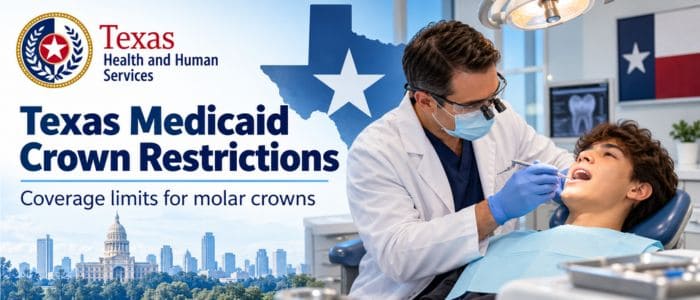
 Texas Medicaid continues to restrict dentists from using some of the most widely accepted crown materials when treating patients’ permanent molars. This outdated policy must change.
Following consultation with dental professionals, TDMR urges the Texas Health and Human Services Commission (HHSC) to extend reimbursement eligibility for two existing dental procedure codes, D2740 and D2751, to permanent molars.
According to 2024 statistics attributed to Glidewell, one of the nation’s largest dental laboratories, zirconia accounts for 86.7% of posterior crown restorations, E.max for 6.1%, and porcelain-fused-to-metal crowns for 5.4%.
Together, these materials represent an estimated 98.2% of posterior crown restorations in the reported figures.
Yet Texas Medicaid restricts reimbursement for D2740, covering porcelain and ceramic crowns, and D2751, covering porcelain fused to predominantly base metal, to anterior teeth and premolars.
Permanent molars are excluded.
Why does Texas Medicaid deny reimbursement for materials that have become overwhelmingly popular in modern restorative dentistry?
Molars withstand substantial chewing forces, so choosing durable restorative materials matters. Dentists should be able to choose the most appropriate crown based on clinical necessity and the individual patient’s needs.
Instead, Medicaid reimbursement rules limit that professional judgment.
HHSC needs to change this policy
Texas Medicaid’s policies should reflect contemporary dental practice rather than unnecessarily restrict treatment options.
If zirconia, E.max, and porcelain-fused-to-metal crowns account for an estimated 98.2% of posterior restorations, HHSC should be able to explain the clinical justification for excluding these materials from reimbursement for permanent molars.
If no compelling clinical justification exists, the restrictions should be removed.
Texas Medicaid patients deserve access to modern restorative dentistry, and their dentists deserve the professional flexibility to provide it.
I know that one of the MCO’s will consider zirconia for molars under EPSDT consideration. If the crown is medically necessary, It can be covered.
As a prosthodontist serving Medicaid patients in the Rio Grande Valley, I treat adults and seniors with partial edentulism, particularly Kennedy Class III cases, as well as extensive dental wear, recurrent caries, failing restorations, and high caries risk.
The first and second molars are essential for maintaining occlusal stability, distributing chewing forces, and protecting the remaining dentition, including anterior teeth.
For many of these patients, zirconia crowns are an excellent restorative option because of their strength, durability, esthetics, and biocompatibility. Restoring teeth is not just about function; it also affects appearance, confidence, and overall quality of life.
Why should we lower the standard of care simply because these patients have Medicaid? Many are hardworking adults and seniors who have contributed to this country throughout their lives. They deserve quality dental treatment just like everyone else.
Traditional metal crowns may present concerns such as nickel sensitivity in susceptible patients, corrosion, and esthetic limitations. Extensive composite restorations also have limitations when exposed to heavy occlusal forces and high caries risk.
Our job is already challenging, and choosing less durable materials when better clinical options are appropriate can make treatment even more complicated.
Quality dental care should not be a privilege reserved for patients with better insurance. Medicaid patients deserve durable, functional, esthetic restorations that protect their oral health and dignity.
This is absolutely correct. Not covering proper restorations leads to eventual tooth loss for the patient if they do not receive treatment.
They also need to increase the price for D2740 ($252.25)!