

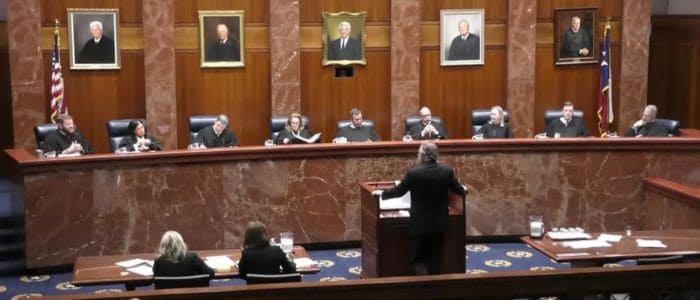
 Twelve years after Texas Medicaid dentists sued ACS/Xerox/Conduent over its handling of orthodontic prior authorizations, the Texas Supreme Court has ruled that the company had no legal right to bring its latest appeal.
The Court vacated the 2024 opinion of the Third Court of Appeals and sent the lawsuit brought by M&M Orthodontics and Drs. Scott and Diana Malone back to the trial court for further proceedings.
In plain English, Conduent is not a governmental unit simply because it performed work for the State of Texas. It is a government contractor.
That distinction deprived the appeals court of jurisdiction to hear Conduent’s immediate appeal from the trial court’s refusal to dismiss the dentists’ lawsuit.
Even the Court is tired of this saga
Justice James Sullivan, writing for the Court, acknowledged the extraordinary history, calling it an “avalanche of legal proceedings.”
Rather than recount everything, Sullivan offered what he called the “short, short version,” complete with a citation to the movie *Spaceballs*.
The State hired the company now known as Conduent to review Medicaid orthodontic prior authorization requests. According to the State’s subsequent lawsuit, the company rubber-stamped requests in violation of Medicaid policy and cost the government millions of dollars.
As the Supreme Court succinctly described what followed: “It didn’t go well, and everyone sued each other.”
Texas eventually obtained a $236 million settlement from Conduent. The Malones, meanwhile, paid $2 million to settle the State’s Medicaid fraud claims against them.
The dentists then filed their own lawsuit against Conduent, alleging the company harmed them by approving prior authorization requests without properly reviewing whether the proposed treatment met Medicaid’s medical-necessity requirements.
Their position has always been that if Conduent had done its job properly in the first place, dentists would not have provided approved treatments only to face payment holds, fraud allegations, repayment demands and devastating harm to their practices and reputations.
Conduent is not the government
After the trial court refused to dismiss the lawsuit, Conduent immediately appealed. It argued that it was protected by the State’s sovereign immunity and qualified as a State employee or agent under Texas law.
The Supreme Court did not decide whether those immunity arguments ultimately have merit. Instead, it ruled that Conduent was not legally entitled to bring an immediate appeal under either of the statutes it invoked.
The first statute permits an immediate appeal when a trial court grants or denies a jurisdictional plea filed by a “governmental unit.”
The problem for Conduent was simple: it is not one.
Unlike public charter schools, private university police departments and ERCOT, Conduent was not given governmental status or authority by the Texas Legislature. Its authority came from its contract with the Texas Health and Human Services Commission.
“Conduent is a government contractor, not a ‘governmental unit,’” the Court held.
The company also pursued another statutory route, seeking immediate appeals involving immunity claims by an individual State officer or employee. That argument failed because Conduent is a limited liability company, not a human being.
As the Court explained, Conduent may be a legal “person,” but it is not an “individual.”
A victory, but more delay may be coming
The ruling ends Conduent’s current appeal and sends the dentists’ lawsuit back to the trial court.
However, it does not finally resolve whether Conduent can claim sovereign immunity. The Supreme Court vacated the entire 2024 appellate decision, including the portion rejecting Conduent’s immunity arguments.
The Court also suggested that the trial judge may want to authorize a permissive interlocutory appeal, which could let the immunity questions return to an appellate court through a different legal door.
In other words, the dentists have defeated this appeal, but they may not yet be heading directly to trial.
That possibility is particularly troubling given the extraordinary delay already involved. At the September hearing, attorney Jason Ray told the Court that two dentists in related cases had died while the litigation was pending. Conduent also waited five years after the lawsuit was filed before raising its immunity arguments.
The providers were pursued by the State over treatments its own contractor had approved. The State collected $236 million from that contractor. Yet the dentists have spent more than a decade trying to obtain compensation for the damage they allege the same contractor caused.
For now, their lawsuit is still alive and returning to the trial court.
Whether the dentists finally get their day in front of a jury, or are sent through yet another round of appeals, remains to be seen.